




Nobody enjoys handing over a lab form without knowing what it’s going to cost. If you have lived in Cyprus for any length of time, you have probably heard that blood work here is cheap, and that is mostly true. Blood test prices in Cyprus depend on whether you go through GESY, whether you have a referral in hand, and which boxes your doctor happened to tick on the form. Here is a look at what you will actually pay, and where the surprises tend to hide.
What Do Blood Test Prices in Cyprus Actually Look Like?
There are two tracks, and almost everything comes down to which one you are on.
The first is GESY, the General Healthcare System. If you are registered and your personal doctor or a specialist has referred you, you pay a small co-payment at the lab and the Health Insurance Organisation settles the rest directly with the provider. The second is private, where you pay the lab’s own price list, either per test or as a bundled panel. The confusing part is that both tracks often happen in the same building, with the same phlebotomist and the same machines, only the billing changes.
How Much Does GESY Charge for Lab Work?
Under GESY, the co-payment is 1 euro per laboratory test or group of tests, with a maximum of 10 euros per category of tests. Your personal doctor costs nothing to see. A specialist visit is 6 euros with a referral, or 25 euros without one. Prescriptions run 1 euro per item, capped at 15 euros per prescription.
There is also an annual safety net. Co-payments are capped at 150 euros per person per year, with a lower ceiling of 75 euros for pensioners and certain low-income beneficiaries. Once you hit it, you stop paying. If you want to see where you stand, the beneficiary portal shows a running total, and the lab statement you receive after testing usually lists your year-to-date figure too.So for a routine full blood panel plus a urine test, a GESY patient is typically only looking at a couple of euros.
What Does GESY Not Cover?
This is the part most people find out at the counter, so it’s worth knowing in advance.
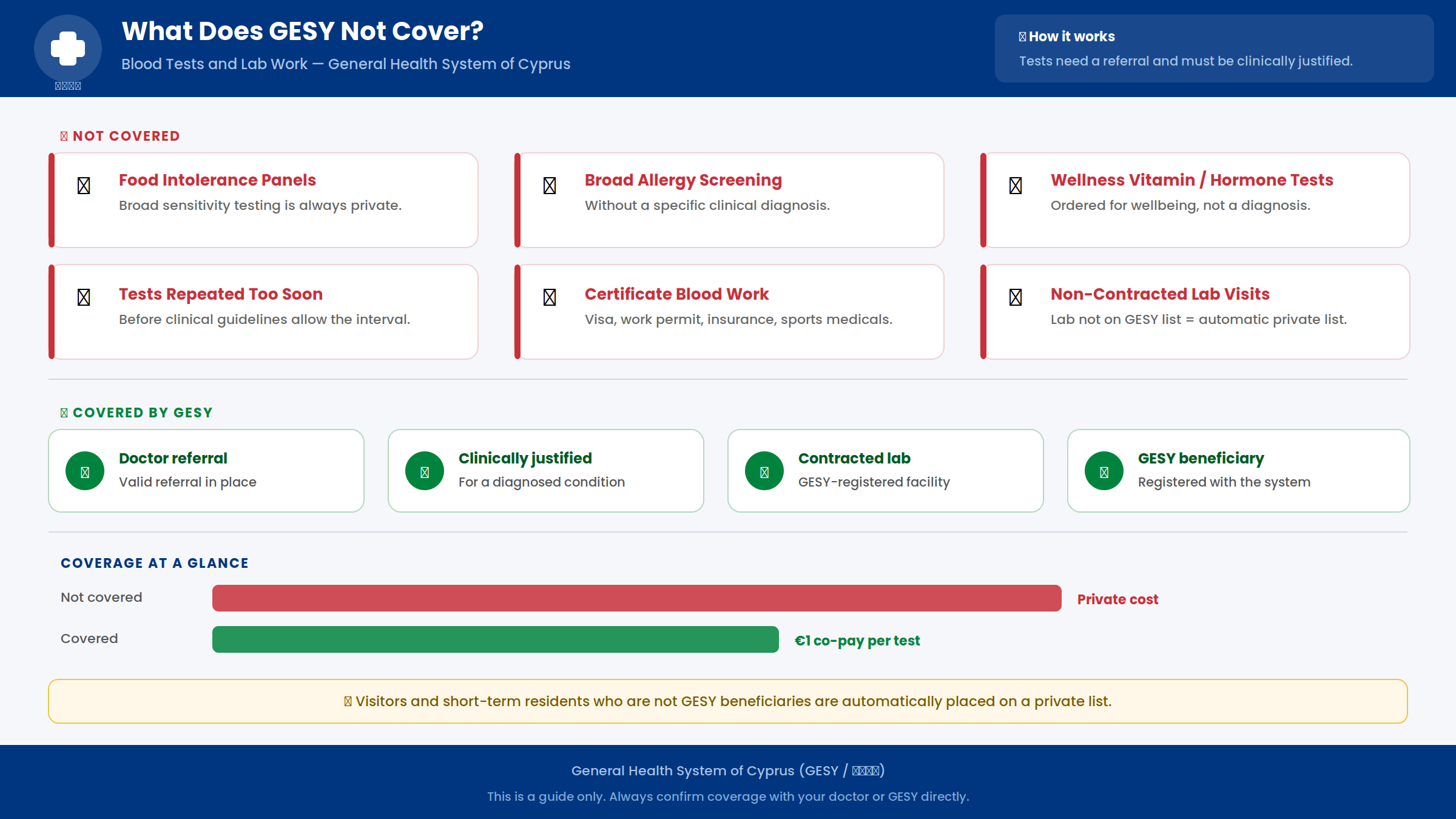
GESY lab testing is referral-based. Your personal doctor or a referring specialist has to order it, and the tests have to be clinically justified. You cannot walk in, hand over a wish list, and pay 1 euro each. That would be nice, but not how it works.
Testing that sits outside that framework is generally private. That commonly includes food intolerance panels, broad allergy screening, some vitamin and hormone markers ordered for general wellness rather than a diagnosed concern, and testing that is repeated sooner than clinical guidelines suggest. Certificates also fall outside the system, so blood work required for a visa application, a work permit, insurance underwriting, or a sports medical is nearly always paid privately. And of course, if you are not a GESY beneficiary, or the lab you have chosen is not contracted with the system, you are automatically on a private list. Visitors and short-term residents fall into this group most often.
How Much Do Private Blood Tests Cost in Cyprus?
As a rough guide, common single markers such as a full blood count, glucose, or a lipid profile tend to sit at the lower end, in the region of 10 to 25 euros each. Thyroid work usually costs more once you add T3, T4, and antibodies. A general check-up panel bundling the standard markers is commonly priced somewhere in the 50 to 120 euro range, and comprehensive screening panels covering hormones, vitamins, iron studies, and detailed organ function climb higher again. Every lab sets its own list, and prices move. The one number that matters is the one your chosen lab gives you beforehand which is why it is always worth asking for the total up front rather than assuming. What you get in exchange is speed and control. No referral, no waiting for a GP appointment, and often same-day or next-day results.

Why Do Blood Test Prices in Cyprus Vary So Much Between Labs?
Two labs a few kilometers apart can quote noticeably different figures for what sounds like the same test. Some markers can be measured several ways, and the more precise methods cost more to run. Some specialized tests are not performed on the island at all and get sent to a reference laboratory abroad, which adds shipping, handling, and turnaround time to the price.
A panel is usually cheaper than ordering the same markers individually, because the fixed costs of the visit and the draw are spread across everything in it. If you need several tests, ask about a panel rather than building your own list one line at a time. Then there are the extras that do not always appear in the headline price: a phlebotomy or draw fee, a charge for a home visit, an urgent-result surcharge, or a fee for a written interpretation. Ask for an itemized quote and you will avoid nearly every unpleasant surprise.
How Can You Keep Your Testing Costs Down?
A few habits make a real difference. Before you leave your doctor’s office, ask which of the ordered tests are covered under GESY and which are not. It takes ten seconds and it is the single most useful question you can ask. If some are private, you can decide then whether you want them.
Group your tests into one visit where clinically sensible, so you pay one draw fee instead of three. Keep copies of your results, because a lab report from four months ago can save you repeating a test unnecessarily. Check your annual co-payment total if you are a frequent patient, since you may already be at the ceiling. And if mobility or work hours are the problem, ask about home collection before assuming it costs extra, because some labs include it.
If you would rather have the answer than the estimate, Konomou Laboratory handles both GESY and private patients, so you can find out exactly what your form will cost before you commit to anything. We offer services such as gentle pediatric phlebotomy for younger patients, and free a home visit appointment if getting to the lab is difficult. Panels range from a general check-up through metabolic, fatigue, allergy, and food tolerance testing. Call us or book online, and ask us to talk you through the pricing. Clear answers, no guesswork.